

Updates
Nordic Seaweed Conference
On the 7-8th October, PROTEUS postdoc Sophie attended the 15th Annual Nordic Seaweed Conference in Grenå, Denmark. Sophie gave the opening keynote talk on her research, "Assessing the environmental impacts of the European seaweed industries: From cultivation to wild harvesting".
Over the two days, the conference covered a wide range of seaweed topics from both research and industry perspectives, including seaweed cultivation and production, Fucus and Ulva biology, food safety, biorefinery and high-value compounds, and developing markets and innovation.
There were also plenty of fun opportunities to mingle and connect with other seaweed enthusiasts, including the "seaweed happy hour" and poster session. The conference dinner hosted in the Kattegatcentret aquarium, was also a magical highlight where the scientists shared their dinner time with the sharks and sturgeons with a live music performance from local singer Gunnva.


Jane's Journey
Between August-September 2026, the GEcoKelp team hosted Dr. Jane Edgeloe, a post-doc researcher from the University of Western Australia at the IMR research station in Arendal. Jane has a background in kelp genomics and was here to assist in the processing of Laminaria hyperborea samples collected during research campaigns across Norway and the Northeast Atlantic. During her visit, she carried out DNA extractions and prepared samples for library preparation, contributing to the ongoing work to understand kelp diversity and responses to environmental change. The visit also provided a valuable opportunity to exchange knowledge, develop laboratory skills and strengthen research connections between UWA and IMR.

Safety Scenarios
Over summer, GEcoKelp and PROTEUS team members Thomas, Hannah, Sophie and Antoine refreshed their old skills and learned some new ones as part of their STCW Basic Safety Training. The course is an international certification for anyone working on commercial vessels and provides them with key knowledge and practical skills needed to handle onboard emergencies, ensure safety and protect the marine environment. The course included 8-hours of online learning with quizzes, followed by two-days of practical training. On day one the team refreshed their knowledge of first aid procedures, but also practiced putting out fires using a range of extinguishers and hoses. They did an indoor 'escape room' style activity too, which highlighted the importance of being familiar with your surroundings. On the second day they spent time learning how to use survival suits and safety rafts in an indoor pool - needless to say, they were all a little soggy afterwards! While it is hoped that they will never need to use any of these skills, the team had great fun learning them and feel much more prepared for their next adventure!

Svalbard Science - September 26
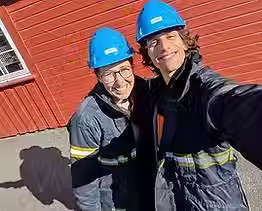
In early September, members of the GEcoKelp team (Karen, Kjell Magnus, Jon) joined forces with the BlueArc team (Albert, Haakon, Sidsel), and researchers Sophie and Even from IMR for another adventure to Ny-Ålesund (Svalbard). Together they had 10-days to complete multiple tasks, although their arrival was a little delayed as their plane could not leave on the first day due to fog! The team made the most of the unplanned layover in wonderful Longyearbyen, with some sightseeing, local cuisine and of course, science chats/planning.
Thankfully, the next morning the fog had lifted, and the small 14-seater plane was able to take them to the research station. From the moment they landed it was straight to work: prepping baited remote underwater video (BRUV) setups, diving activities to collect kelp and urchins, field and lab urchin experiments and carbon sampling. Some of the BRUVS were also deployed by collaborators in other areas of Svalbard, with a rather big suprise caught on camera in Hornsund (check out the video below). As with previous trips, the work relied heavily on the infrastructure and support at Ny-Ålesund.
Beyond the science, trips like this put you shoulder to shoulder with researchers working on completely different systems and questions, with conversations over meals and downtime important for sparking new ideas and collaborations. The team are now back and busy processing data from the trip (and planning for their next adventure!). Keep an eye out to see what they find!


.jpg)



Diving Days
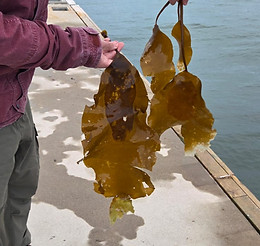
In mid-September, GEcoKelp team members Thomas and Hannah, plus IMR dive supervisor Jonas made the most of the sunshine and calm seas and headed out for some diving fieldwork. Over three days the team visited several long-term monitoring sites in southern Norway where they undertook surveys of seaweed communities across depth bands. This work will help us understand changes in the area over time, as marine ecosystems in sourthern Norway are vulnerable to stressors including ocean warming and marine heatwaves, coastal darkening and blooms of turf algae known as "lurv".
The team also made the most of the opportunity and collected some Laminaria digitata samples for morphology and genetics as part of an ongoing investigation by Hannah, and some Laminaria hyperborea and Saccharina latissima samples for bulk biomass as part of an ongoing collaboration between Thomas and researchers in Australia.


Investigations in Iceland
In August 2026, a small GEcoKelp team comprised of Thomas, Hannah and Jon returned to Iceland for a workshop and baseline data collection with collaborators Karl and Lilja from Iceland's Marine and Freshwater Research Institute.
During the first week of the trip, the team were based out of Reykjavik and spent time at the research institute where they undertook some intertidal fieldwork, some sea urchin grazing experiments and had several productive grant and manuscript writing sessions.
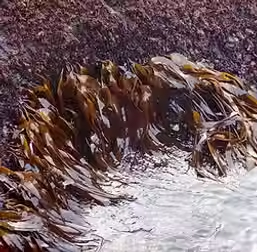
For the second part of the trip, the team headed 5-hours north to the town of Akureyri to visit some of Karl's historic kelp forest research sites. During this time, they processed kelp samples for morphology (length, biomass and age) and took samples for genetic analyses.
On a rare 'quiet' afternoon during the trip, Thomas and Hannah made the most of the sunshine and squeezed in a quick road trip to see some of the geological highlights near Akureyri including Goðafoss waterfall, the Lake Mývatn, the Dimmuborgir lava fields, the Grjótagjá cave, and the mud pools and steaming fumaroles at Hverir!


.avif)

.avif)

Portugal - Pop-up lab & Plenary
GEcoKelp lead Thomas' has recently visited Portugal to attend the 59th European Marine Biological Symposium (EMBS) that was held in Peniche between 7-10th July 2026. He presented a symposium plenary on climate-driven threats to marine species and kelp forests. GecoKelp team member Kjell Magnus also attended the conference and gave a talk on the historical and current drivers of kelp forest distribution in Norway.
The trip also included a productive visit to Dr João Franco in Porto, with the duo sampling the kelp Laminaria hyperborea at its warm range edge for genetic analyses of adaptive responses to warming. Thomas also met with long-term collaborators from SeaForester — Paal Bakken, Jan Verbeek and Ari Greenberg — to discuss ongoing kelp restoration efforts and potential partnerships.
These exchanges strengthened international collaborations and provided new samples and insights that will feed directly into GecoKelp’s research on kelp vulnerability and adaptation.


Heatpads in the heat
At the end of June, the GEcoKelp team welcomed Dr Shinae Montie from the University of Western Australia to the IMR research station in Arendal. Shinae, Antoine and Hannah had received collaborative funding to develop and test a novel heatpad set-up used in Shinae's PhD research in Norway. With the help of Proteus post doc Sophie, BlueArc PhD student Sidsel, and volunteer Tom, they spent the week sourcing materials and constructing the heatpads so they could investigate the influence of heating/cooling on the survival of kelp and recruitment of macroinvertebrates in a field environment. During this time, they also received a visit from GEcoKelp advisory board member Prof Mads Thomsen from the University of Cantebury in New Zealand. While a small technical glitch prevented the deployment late on the Friday afternoon, the team will continue to develop the set up over the next few months and hopefully deploy it when Shinae and Antoine return to Norway in Autumn.


.jpeg)


.jpeg)
Harvesting surveys in Nordland
In early June, some of the PROTEUS team (Sophie and Henning) headed to Nordland to collect data on the structure and biodiversity of Laminaria hyperborea kelp forests along a harvesting gradient.
Henning, along with IMR colleague Lene, conducted routine annual sampling surveys to assess the status of the kelp fields due to be harvested next year. This important information is used to advise on which fields can be opened, based on the status of their recovery since the last harvest (typically 5 years prior). Henning uses underwater video transects to measure the cover, height and density of kelp each June, ensuring comparability across years. Targeted sampling enables the biomass, ages and epiphyte cover of the kelps to be determined, and acoustic monitoring is used for large-scale biomass estimates of kelp forests that can be repeated efficiently across many stations and seasons. These approaches and research cruises are integral for monitoring the sustainability of the harvesting industry in Norway.
This year, Henning also collected stipes and holdfasts for Sophie and volunteer Tom to process and assess the biodiversity impacts of harvesting. Kelps were collected from unharvested areas and areas harvested last year (2025) to assess differences in the associated epiphyte and faunal assemblages. A combination of traditional taxonomy, and newer metabarcoding and eDNA approaches will be compared for this work.
Luckily, the weather was kind for most of the research cruise and all the samples could be collected, with very large L. hyperborea kelps up to 16 years old recorded in the unharvested areas. Between long field and lab days, with 22 hours of daylight, the team also found some time to explore the beautiful and dramatic scenery nearby. Stay tuned for their findings...


Surveys in Svalbard
In mid-May, GEcoKelp (Thomas, Hannah and Antoine) joined forces with the BlueARC (Haakon, Sidsel, Jon) project for a trip to Ny-Alesund (Svalbard). This is their third trip to the Arctic, with a fourth trip planned for September 2026.
Arriving in Ny-Ålesund was breathtaking, with mountains rolling, fjords thick with ice and snow. With barely a moment to take it in, the team started to plan the coming 10 days with a full schedule of lab and field work. First on the agenda was to figure out how to catch urchins for some grazing experiments, with initial trials only managing 2-3 urchins (and 96 needed!) but started trawling from a small boat on urchin barrens and soon they had a handful of urchins to begin experiments. Boat time was also put to good use collecting stunning dropcam footage at multiple locations within Kongsfjorden.
The drop-camera surveys took the team to several sites around the fjord, where they recorded the distribution of kelp forests and urchin barrens. This work helps us track ecological changes in Kongsfjorden and assess how the balance between these habitats is shifting over time. Working from small boats in front of glaciers and steep mountain slopes was a fantastic way to experience the Arctic landscape while collecting valuable data on these changing coastal ecosystems.
Soon after the first team landed, the much-needed diving team arrived, and it was full steam ahead! While the divers headed into the icy Arctic waters daily to undertake kelp forest surveys and collections, the land team kept the genetics processing and grazing experiments running back at the station. They also deployed 'litter bags' containing old kelp blades to investigate how kelp material from multiple species breaks down under Arctic conditions. The bags will remain in the fjord throughout the summer and will be collected at different time points to track decomposition over time. Thanks to the support of the research community in Ny-Ålesund, several of the intermediate samples will be retrieved while we are away.
Midway through the trip, they received an unexpected visitor, a lonesome polar bear that happily napped in front of the dining hall, only to be gently encouraged to move on when it began heading towards town. Belugas, arctic foxes and minke whales were also roaming around the fjord, giving everyone a true taste of the Arctic ecosystem. After a bit more than a week of work, the team had collected all the data they needed and headed back to sunny Arendal to begin the data processing.
Some of the team will return to Svalbard in September to retrieve the final litter bags and continue the drop-camera surveys. It will be exciting to see how much decomposition has occurred during the Arctic summer and to continue mapping the distribution of kelp forests and urchin barrens, hopefully extending our surveys to new areas and sites further out in the fjord. Until then, the experiment continues beneath the surface of Kongsfjorden.


.jpeg)


Aquarium Activities in Arendal


During the spring, the GEcoKelp team and collaborators have been running a large experiment in the aquarium hall at the IMR research station in Arendal to understand how Norway’s kelp forests may respond to ocean warming. To do this, they have set up temperature treatments ranging from 12-23°C, and have had over 1000 kelp transit through the aquarium hall. Each kelp has been given a unique code, and at set timepoints it has been photographed, measured (length, biomass, growth, age), and its photosynthetic activity assessed using a pulse amplitude modulation (PAM) fluorometer. The experiment has run over evenings, weekends and will continue running over a 2-3 month period so we can look at the response to temperature alongside recovery. In addition, we have also been running some ‘side’ experiments/sampling including degradation experiments, genetic sampling, metabolomic assessments and small scale heatwaves using the heatblock.
The work has involved many GEcoKelp team members (Thomas, Karen, Hannah, Antoine, Sophie, Melinda, Tone) and friends/willing volunteers/students (Stian, Sidsel, Tom, Adam, Gokcen, Caroline, Julia, Josephine, Inger, Marcel, Jon, Jeanette, Colette!)
Stay tuned to see what we find 😊


Surveys in Stavanger
At the end of April, GEcoKelp lead Thomas and post doc Hannah went on a speedy trip (less than 24 hours return!) to Stavanger for some kelp surveys/sampling. After a sunset road trip accompanied by Hannah’s favourite car tunes, they were up early to visit their first site. Here they collected various intertidal macroalgae samples including L. digitata for morphology assessments, S. latissima for genetic analyses, and A. nodosum for habitat cascade research. They then met colleagues Jonas and David at a second site where they undertook additional intertidal surveys of L. digitata (much to Thomas’ delight), before undertaking some subtidal L. hyperborea and sea urchin surveys. They got back to the IMR research station late in the evening to store the samples before returning the following morning to monitor the aquarium hall experiment!


Lovely Lofoten

Just after Easter, a GEcoKelp team comprised of Thomas, Antoine, Hanah and Melinda headed up to the Lofoten archipelago for a ‘mini project workshop’ and to undertake some intertidal fieldwork. While the trip got off to a shaky start with delayed planes and missing kit, overall it was a great success!
The team spent time discussing project progress and potential outputs as we enter the final year of funding. They also visited several intertidal sites where they collected and measured sea urchins, adding data to a growing database on their morphology across the NE Atlantic. They also collected samples of S. latissima for genetic analyses and A. nodosum to further the habitat cascade work of Gökcen, Hannah and Mads. The main focus of the trip however was intertidal kelp surveys, which were undertaken at sunset which made for some beautiful photos! The sites were so spectacular that the team hope to head back for some intertidal and subtidal work in the future!
Before heading back home, the team visited a site near Saltstramen (to collect more samples!), which is a famous area of mainland Norway where the ocean current passes with extreme force through a fjord/island passage. While watching the current, the team got a surprise, and incredibly special treat, as a pod of Orca came to play in the current!
.jpeg)
.jpeg)

.jpeg)


Travels in Tromsø
In mid-April, Karen, Antoine and Sophie, along with colleagues from the Norwegian Polar Institute and Akvaplan NIVA, Haakon Hop and Marta Lukasik headed north to Tromsø and the beautiful islands around Sommarøy to monitor and sample kelp forests. They successfully surveyed several Laminaria hyperborea sites and took some samples for an ongoing aquarium experiment. Antoine also collected new samples of Saccharina latissima to further our understanding of genetic variation within this comercially important kelp species. Samples of Ascophyllum nodosum were also collected from intertidal sites for an ongoing effort to assess the importance of this species in facilitating habitat cascades. Luck must have been on their side as the sun shone throughout and all samples and scientists made it back in one piece!


Back with a splash!
Thomas and Karen are back in Norway for the fieldwork season. The weather was great so they got straight in the water to test out their new diving gear with dive supervisor Jonas. Thomas also collected kelps for an exciting upcoming GecoKelp experiment that Hannah and Sophie have been setting up with the IMR team in the aquarium hall.
Stay tuned for more updates!


GEcoKelp Fieldwork
in Runde


At the end of March, a GEcoKelp team comprised of Hannah, Sophie and Gökcen ventured up to Runde (W Norway) for the first regional fieldwork of 2026. The team aimed to:
-
Monitor and survey at four sites where Hannah has patches of tagged kelp she has been monitoring over time.
-
Undertake surveys and collect additional Ascophyllum samples for Gökcens MSc thesis.
-
Process and ship some samples from previous field campaign.
Despite some very early mornings and late evenings, alongside some storm force winds and potential pig interactions, the trip was a great success. The team managed to visit all sites and process all the laboratory samples in good time. They even managed to squeeze in a trip to the exhibition at the enviromental center followed by a hike up the bird mountain (although it was too windy to see the puffins that had recently arrived back).
The team are now back in Arendal processing the data and preparing for the next field trips, stay tuned to see where there next adventure takes them!


Trip to Notpla HQ
Sophie was invited to Notpla HQ in London to talk about the PROTEUS project and the environmental impacts of kelp harvesting in Norway. Notpla are one of the best-known plastic-free packaging companies globally, after winning the Earthshot prize in 2022. As leaders in the sustainable "packaging revolution", it was great to hear about their interest in securing sustainable seaweed biomass for their packaging as demands for their products expand.

Drop Camera Day Out
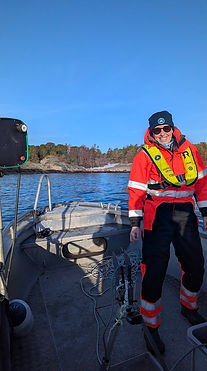
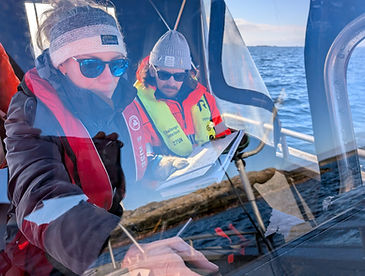
In early March, post docs Hannah (GEcoKelp) and Sophie (PROTEUS), Lene and Tom went out on the first fieldwork of the season to investigate temporal variation in kelp forests. Armed with the drop camera they revisited ~50 sites from the northern tip of Tromøya to Flødevigen. They had one day of cold misty weather and one day of beautiful sunshine, and they managed to stay upbeat despite an array of technical glitches. The videos are currently being analysed, and more surveys may be undertaken in the coming weeks so stay tuned for more updates.


PROTEUS presents to the
Norwegian Seaweed Cluster
Sophie was invited to present her work and the PROTEUS project to the Norwegian Seaweed Cluster in February. She was happy to share the progress and plans of PROTEUS in the online meeting with approximately 40 scientists and stakeholders working across Norway on seaweed farming and harvesting. Talks like this help to share the most up to date information, strengthen partnerships between research and industry and enable us to work towards a more sustainable future for the seaweed sector.

PROTEUS partners meet in Haugesand
In December 2025, Sissel Rogne met with other PROTEUS partners in Haugesand for two productive days of meetings to review the project. They also an exciting visit to the field to see the Hypomar harvesting vessel and Alginor's biorefinery facilities.

Image credit: PROTEUS-cbe
PROTEUS at the Centre for Coastal Research Conference


The annual scientific conference for the Centre of Coastal Research (CCR) took place on Tuesday 9th December at the University of Agder campus in Kristiansand. The CCR is an international and interdisciplinary academic institution hosted by the University of Agder. CCR focuses on the ecology and evolution of the biota in the marine coastal zone within a broad societal context.
Sophie Corrigan from the PROTEUS project went along to learn more about the great diversity of marine research taking place across research institutes in Norway and the wonderful collaborations between them. She also presented her poster on the work the PROTEUS team are doing to assess the impacts of kelp harvesting on biodiversity and came away with many fruitful ideas and connections!

PROTEUS and GEcoKelp at Havforskermøtet
PROTEUS and GEcoKelp were featured at the annual meeting of the Norwegian Association of Marine Scientists, that took place 24–26 November in Arendal. This year’s theme focused on “The effects of pollution and other human impacts on marine nature”.
Sophie Corrigan from the Institute of Marine Research (IMR), Norway, represented the PROTEUS project and shared insights into how our work supports sustainable management of kelp forests and blue ecosystems.
Hannah Earp and Antoinne Minne, also from IMR, represented the GEcoKelp project and gave talks titled "Production–consumption mismatches reveal vulnerability to coastal darkening for kelp forests at the Arctic-boreal interface" and "Genomic diversity and composition of Northeast Atlantic Norwegian kelp forests".
Havforskermøtet offered the opportunity to share updates from these projects with the wider marine sciences field, and connect with researchers across Norway and past (or future!) collaborators.


